
- Task
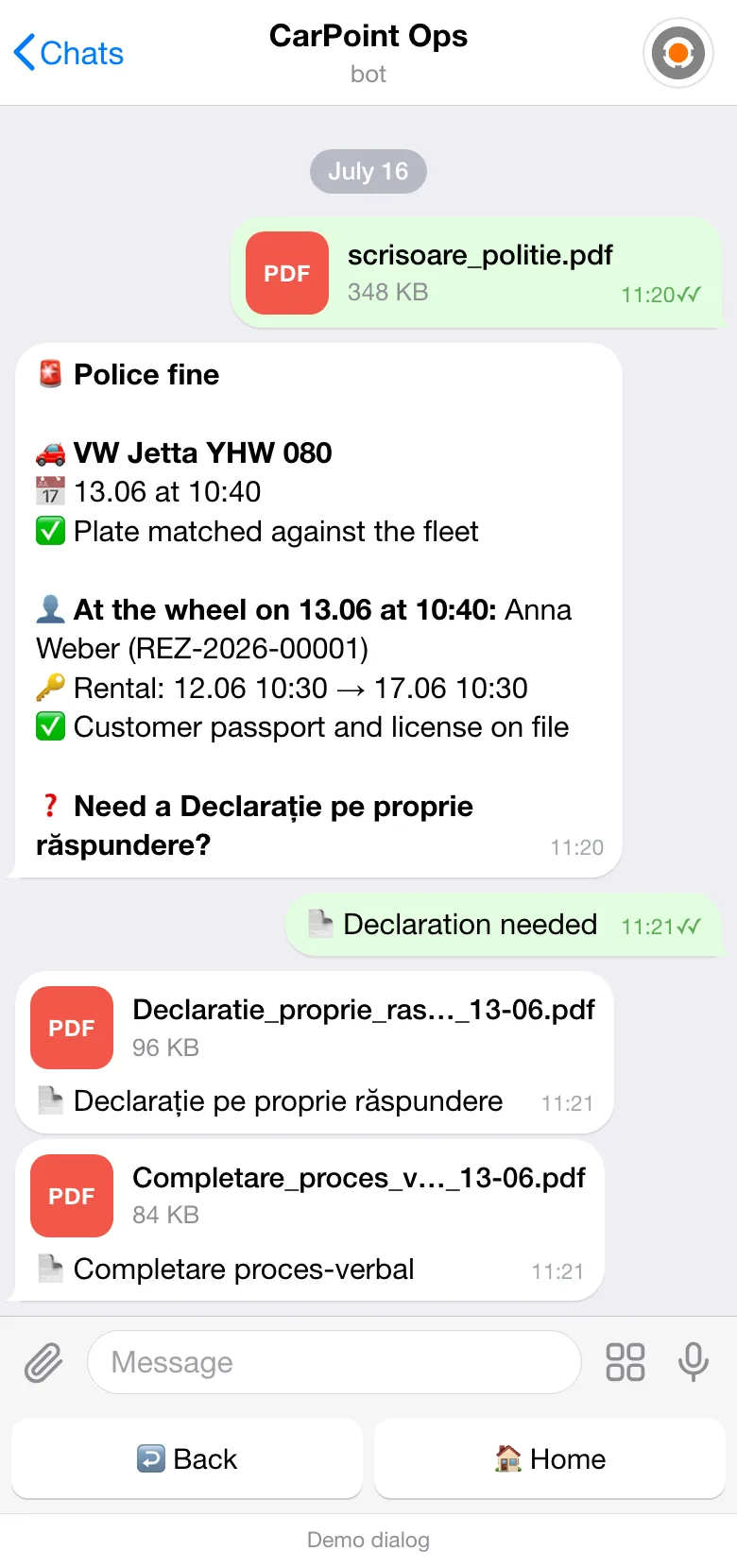
- A police notice arrives about a fine on a company car. Someone has to work out who was driving at the time of the offense and reply with an owner’s declaration.
- Solution
- Someone sends a photo of the notice to the bot. The bot reads the plate number, matches it against the fleet and finds the renter through the calendar and the rental agreement.
- What you see
- The owner’s declaration, ready as a PDF with the renter’s details. No one has to ask around to find out who was driving.
How CarPoint works: from request to ride to payment
Rentals, transfers and tours run on one connected system of websites, bots and automations. We develop it in-house and build solutions for other companies.
16
cars in the fleet
3
lines of business
6
inquiry channels in one inbox
Websites, online booking, Telegram tools and AI assistants are already up and running.
Already running inside CarPoint
Customers choose a car, see when it is free and book it without a phone call. The server calculates the price using the company’s rules, and the booking lands in the car’s calendar together with the data for the rental agreement. The old WordPress site calculated nothing, the options had to be explained to customers by hand, and the calendars were kept manually: first on paper, then in Google. In May 2026 we joined everything into one system, and since then we have reworked the site almost entirely.
- Online booking with a booking number, an email to the customer in their own language and a booking card for the team.
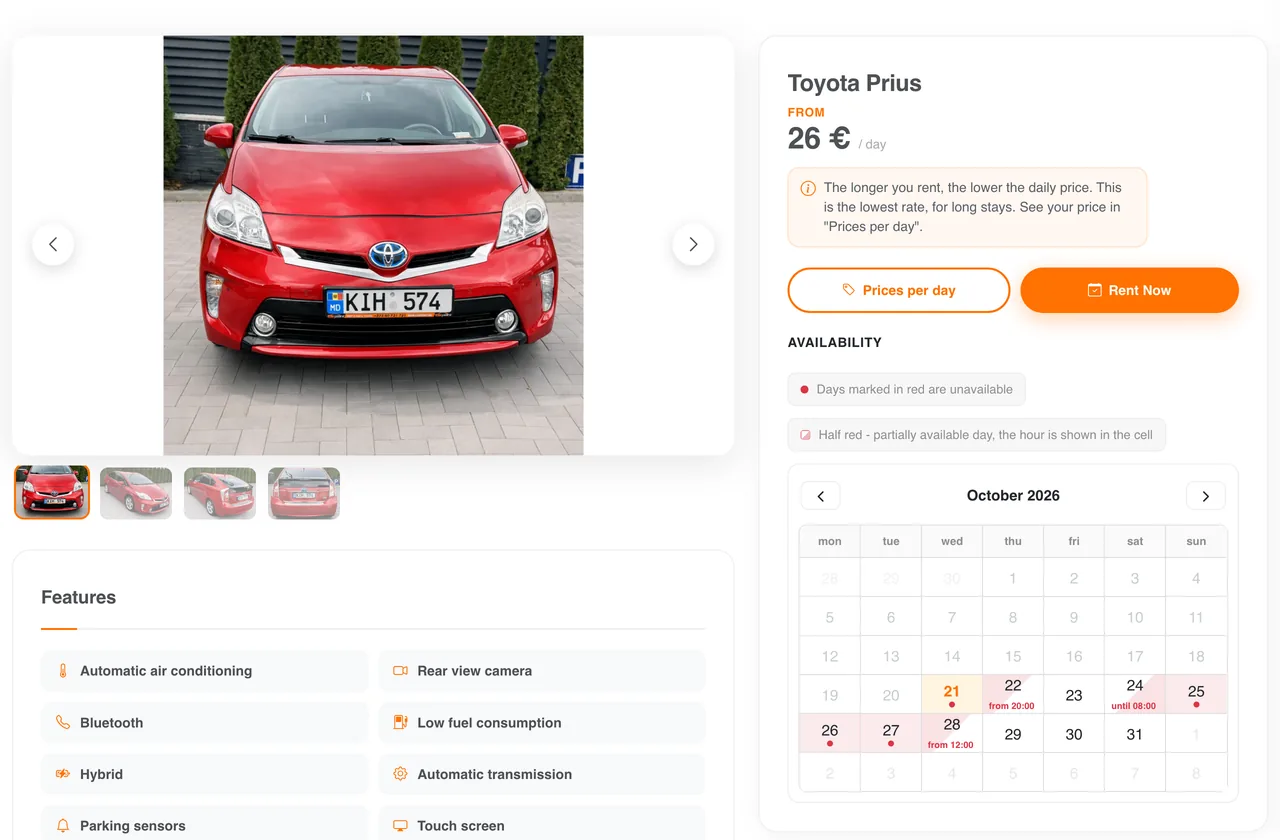
- An availability grid on each car’s page shows the hour the car becomes free.
- The server recalculates the price: rates by rental length, CDW, extras, airport and night-time delivery, coupons.
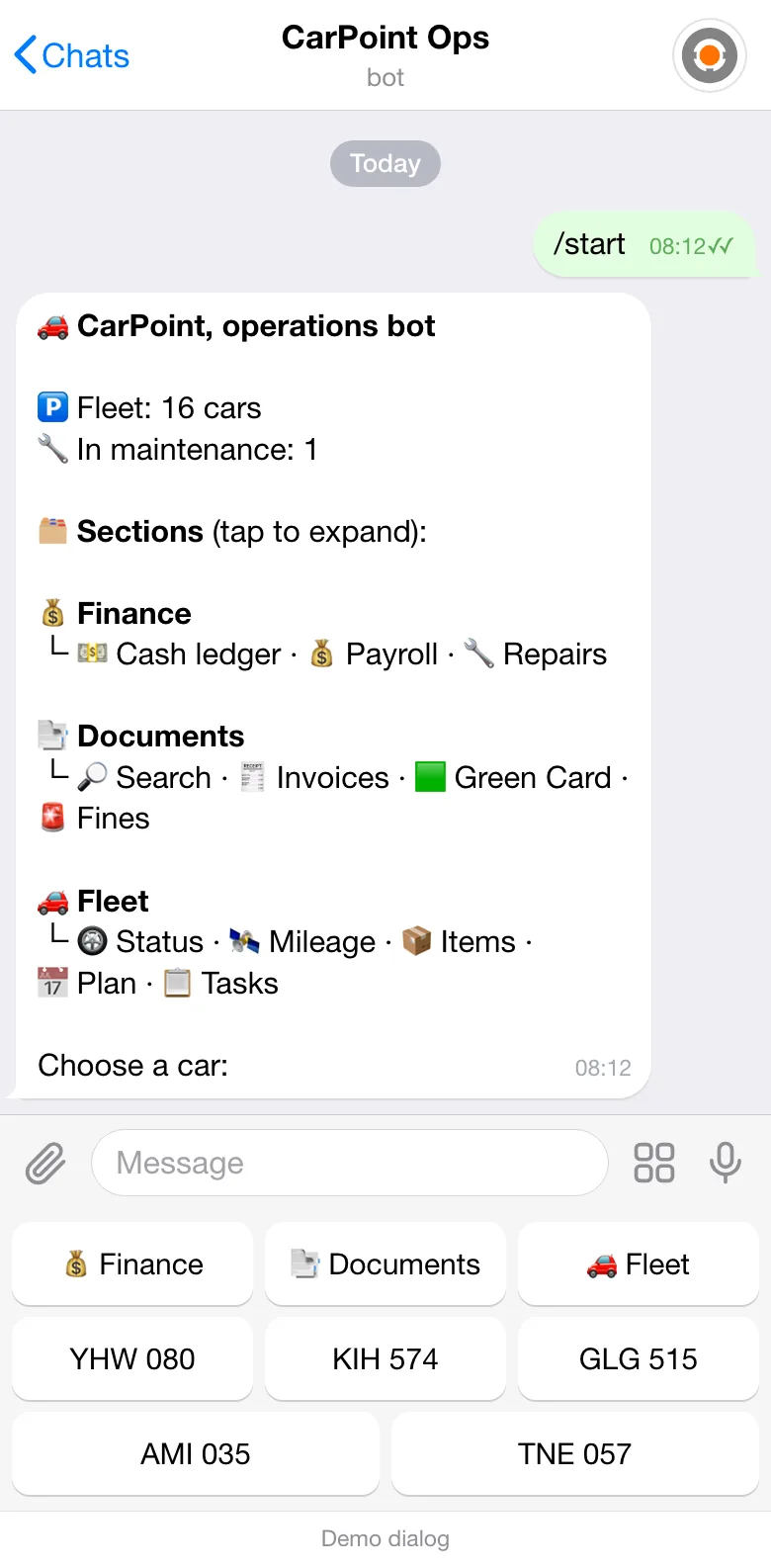
The company’s daily work runs through a private Telegram bot, the main one among CarPoint’s seven bots: fleet, rentals, transfers, documents, fines and driver pay. A photo of a passport, a driver’s license or a police notice is enough, and the bot reads the data itself. Everything is saved to shared spreadsheets, calendars and cloud storage, with no retyping from one place to another. In practice it is the team’s CRM: bookings, customers, documents and payouts in one chat.
- A rental agreement in a few steps: booking, photos of the customer’s documents, deposit, language, finished PDF.
- Returning customers are recognized, and their documents are offered again. Search by name, phone, booking number, or by car and date.
- Transfers: date, available car, driver. The driver gets a calendar invite without the price.
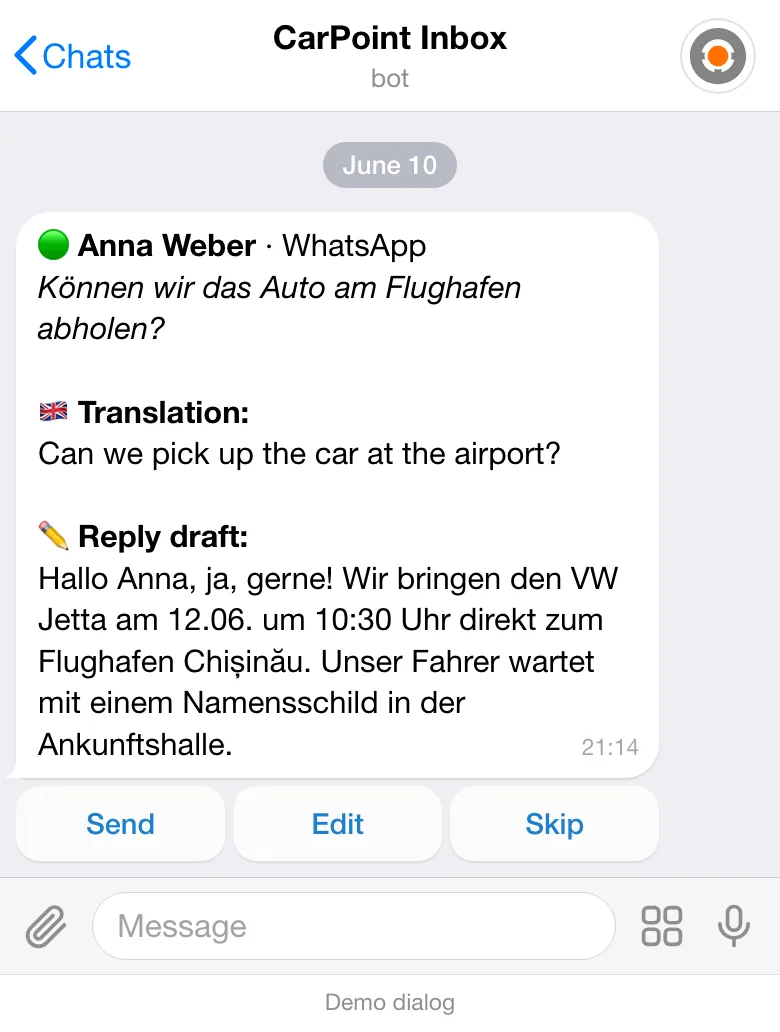
Messages from six channels come together in one Telegram inbox instead of living in separate apps. AI prepares a reply draft in the customer’s language; a person checks it and sends it with a button. Three AI assistants are at work: the inbox copilot, the chat on the rental website and Corneliu’s tour assistant.
- WhatsApp, Instagram, Messenger, email, Telegram and the website chat in one prioritized queue.
- Several messages in a row from one customer merge into one card, and the first message gets a warm hello.
- Edits in Russian, typed or by voice: the reply is rebuilt in the customer’s language.
Corneliu Scurtu’s tours website runs in five languages and sends requests straight to Dispatch. A guide’s draft becomes a branded Moldova4You offer in the customer’s language, with a route map and a PDF. The driver gets a route guide with waypoints for the navigation app; the customer gets their own, with photos and an offline version.
- corneliuscurtu.md: 95 pages in five languages, 14 tour packages, a partner page and a blog.
- A request from the website goes straight into Dispatch along with the source of the visit.
- Tour prices and facts live in one file that feeds the website, the assistants, the blog and the offers.

One order across several screens
Screens use demo data, and interfaces are translated for illustration. Dispatch shows its own demo week.
-
1
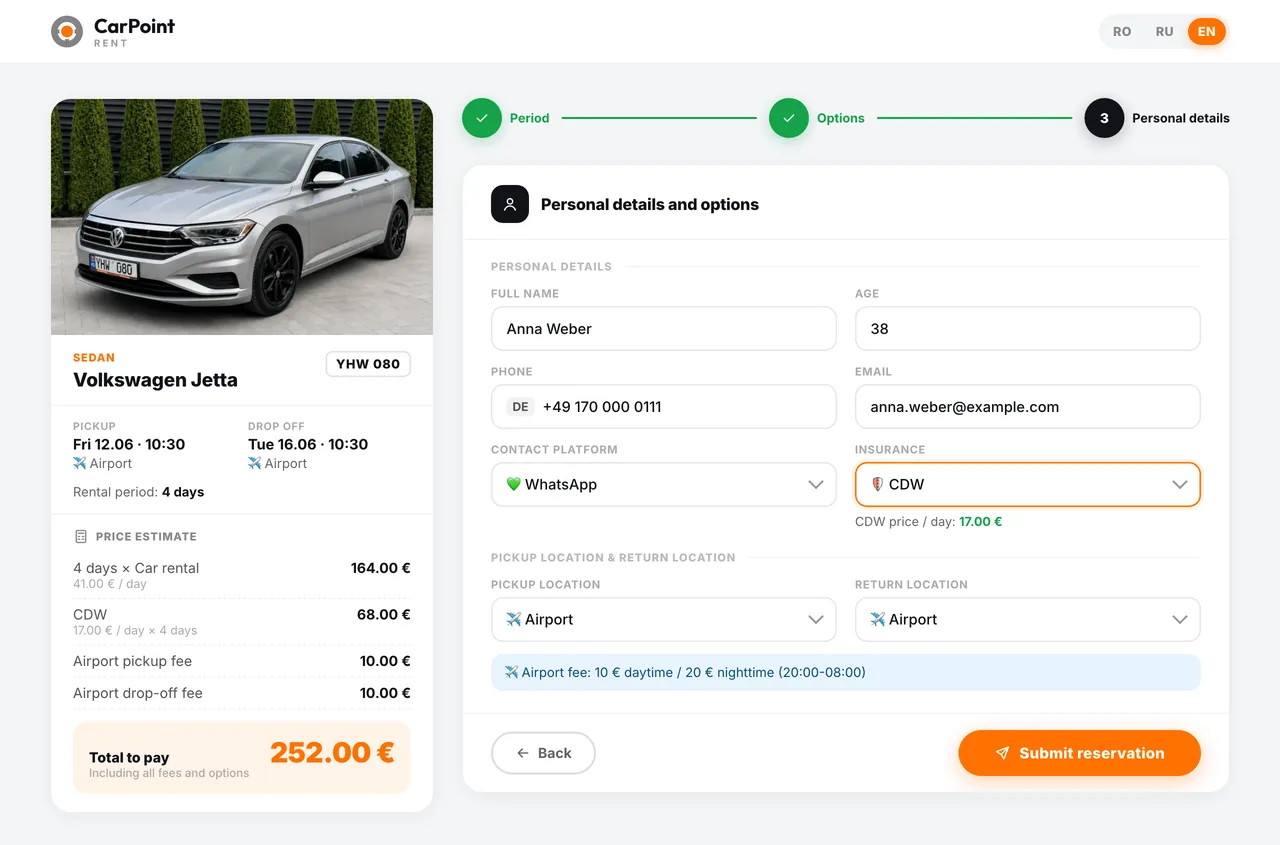
Booking on the website
- Person
- Anna picks a VW Jetta for June 12-16, airport delivery and CDW.
- System
- The website shows the car’s availability by the hour and calculates the price on the server.
- Result
- The €252 total is visible before she submits, and the booking is assigned number REZ-2026-00001.
-
2
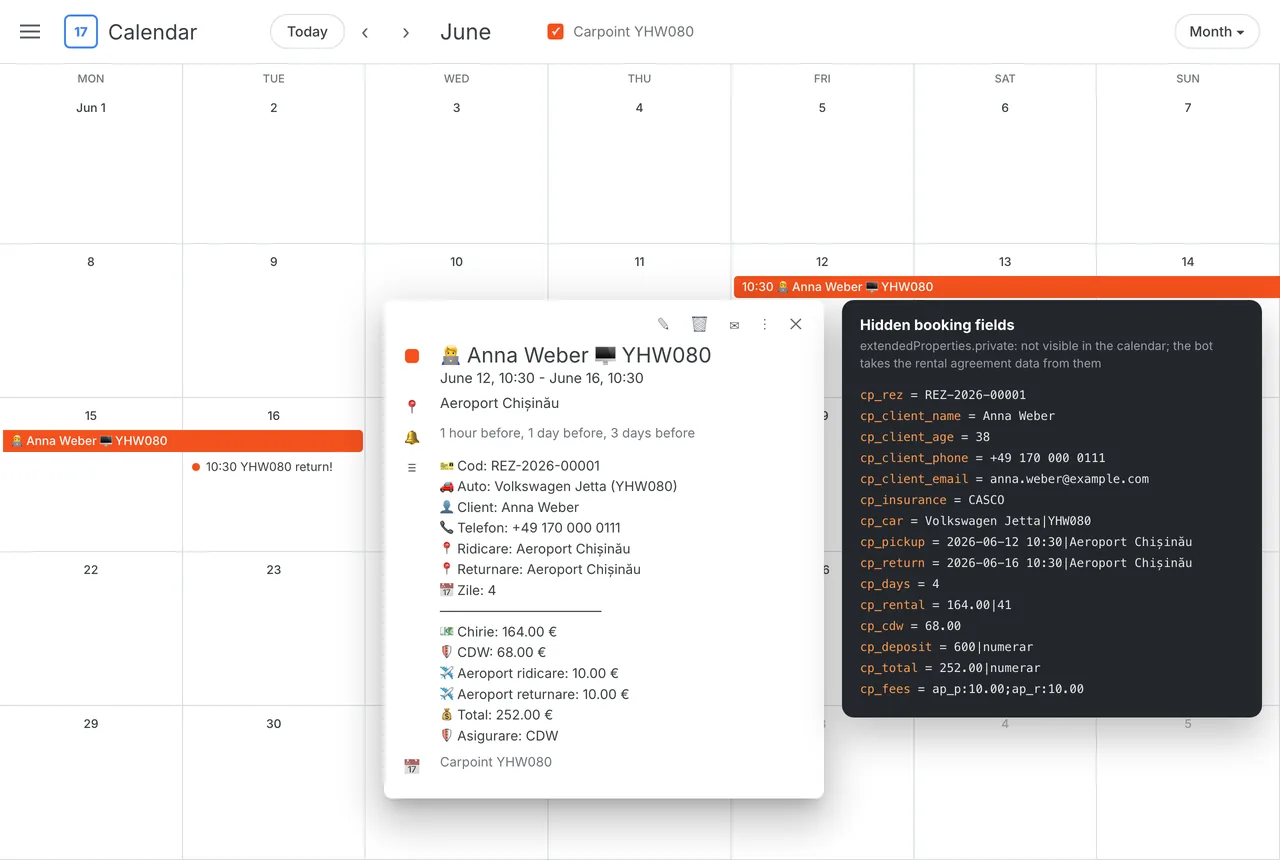
Confirmation
- Person
- The team gets a booking card and doesn’t retype anything.
- System
- An event is created automatically in the YHW080 calendar, with the booking data in hidden fields.
- Result
- Anna gets an email in her language, and later the bot will build the rental agreement from those fields.
-
3
A question on WhatsApp
- Person
- A manager reads the draft and presses the “Send” button.
- System
- The copilot translates Anna’s question from German and drafts a reply in her language.
- Result
- The reply goes out on WhatsApp, and a person has the final say.
-
4
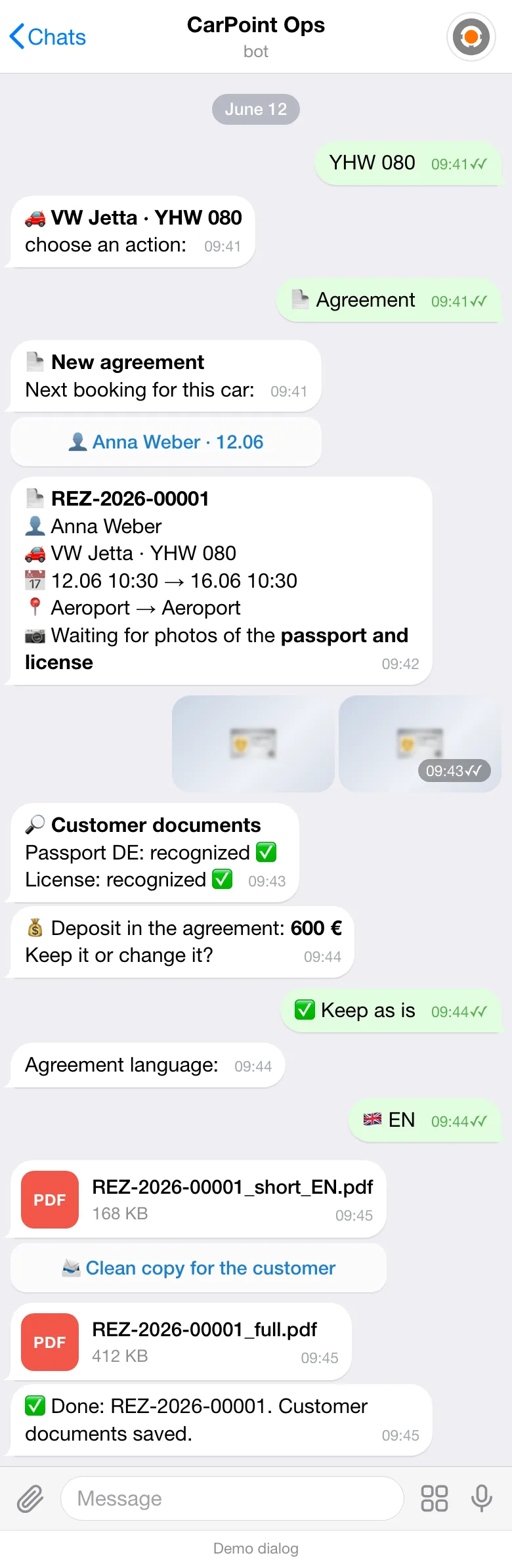
Handover at the airport
- Person
- A staff member picks the car in the bot and photographs the passport and driver’s license.
- System
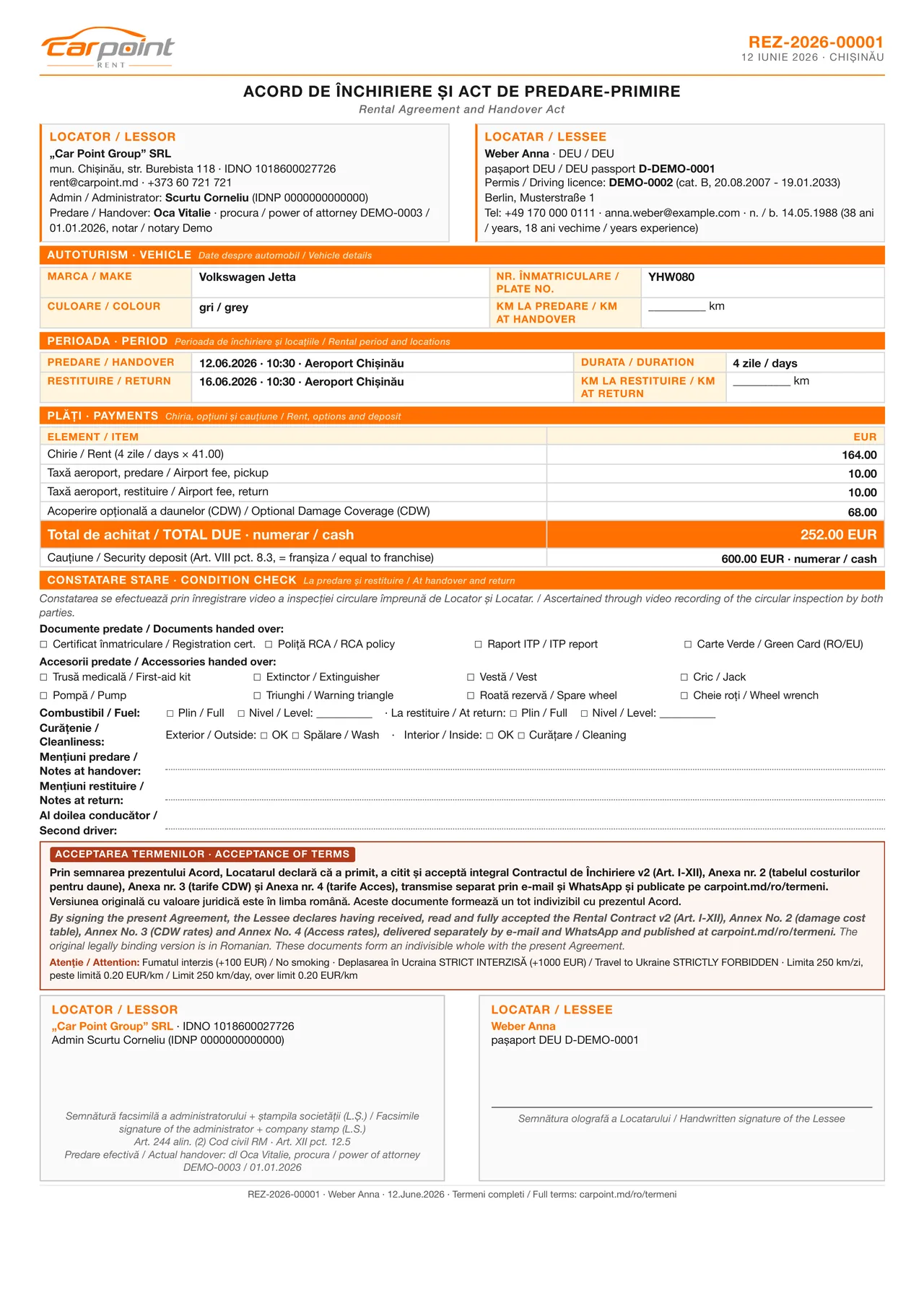
- The bot finds the booking, reads the documents and fills in the rental agreement.
- Result
- The rental agreement as a PDF in English, a copy for the customer and a name sign for the meet-and-greet.
-
5
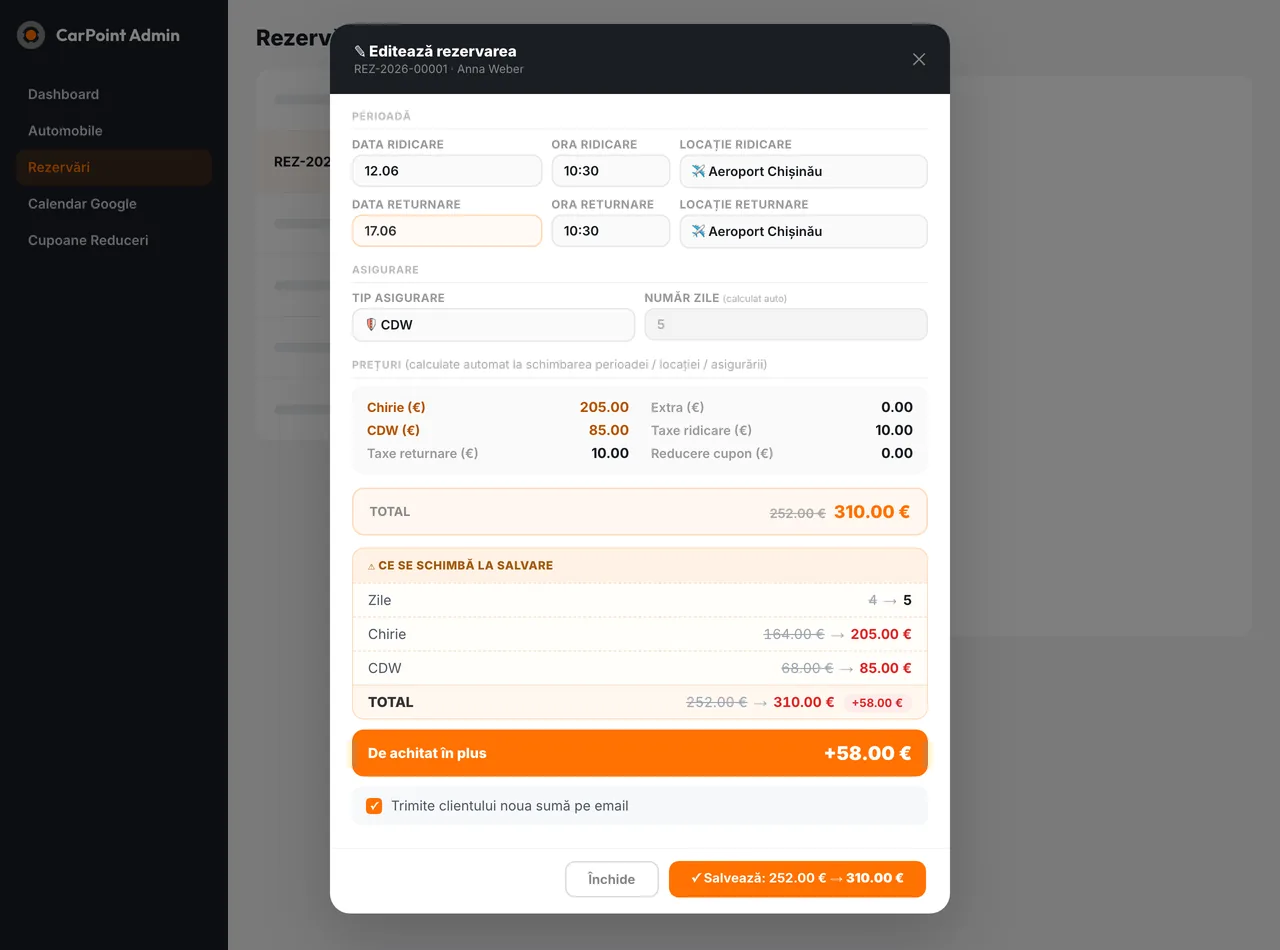
During the rental
- Person
- Anna asks for one more day, and the manager moves the return to June 17 in the admin panel.
- System
- The car is in the daily plan every morning, GPS tracks the mileage, and the admin panel recalculates the rental and CDW.
- Result
- An extra €58 is due, the calendar event moves, and Anna gets an email with the new amount.
-
6
After the return
- Person
- Anna returns the car. A month later, the manager sends a police fine notice to the bot.
- System
- Mileage is checked against the limit, and the bot matches the fine to Anna, who was driving on June 13 at 10:40.
- Result
- The owner’s declaration is ready with no need to find out who was driving, and the next time Anna books, no one has to enter her details again.
-
1
Request
- Person
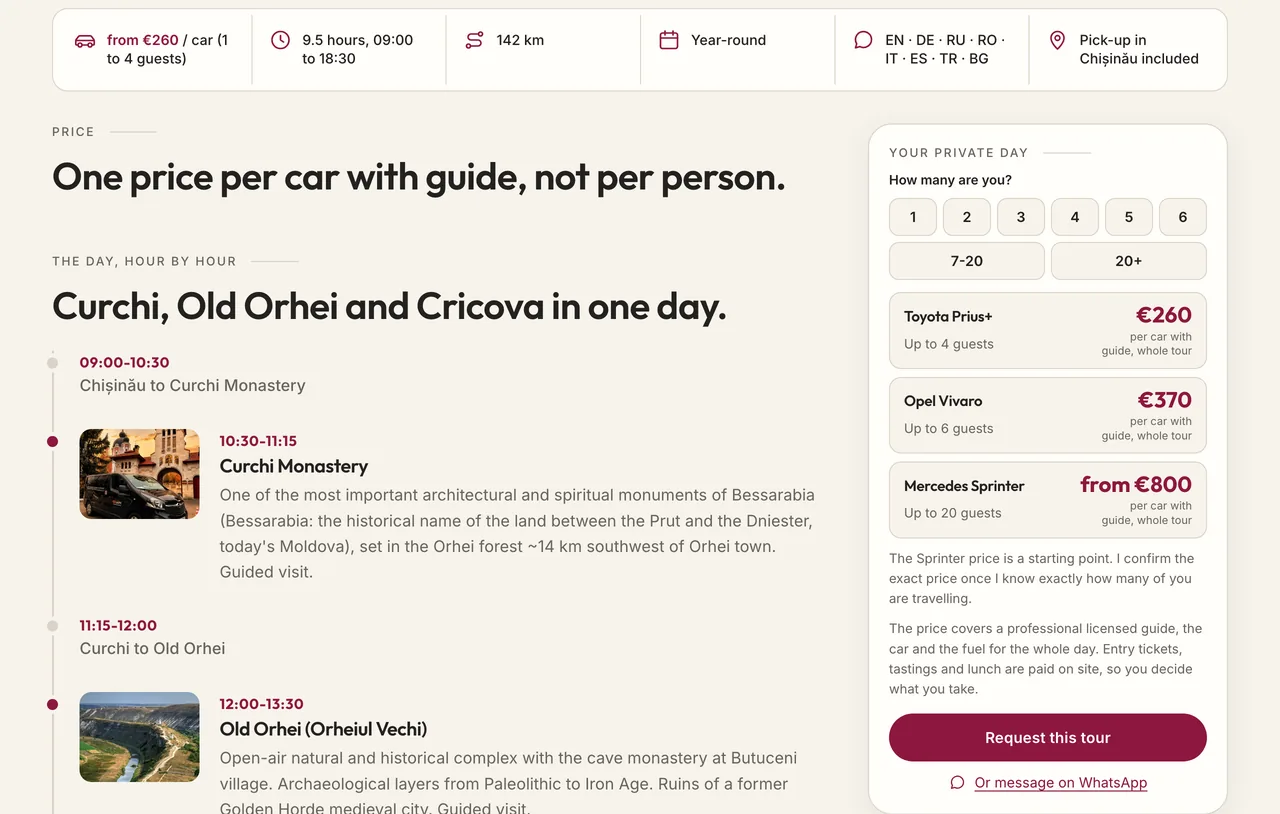
- Anna chooses the number of guests on the tours website and sends a request, or writes on WhatsApp.
- System
- The request comes from the form, or from a messaging app through the assistant, tagged with its source.
- Result
- The team sees who asked, about which tour and where the customer came from.
-
2
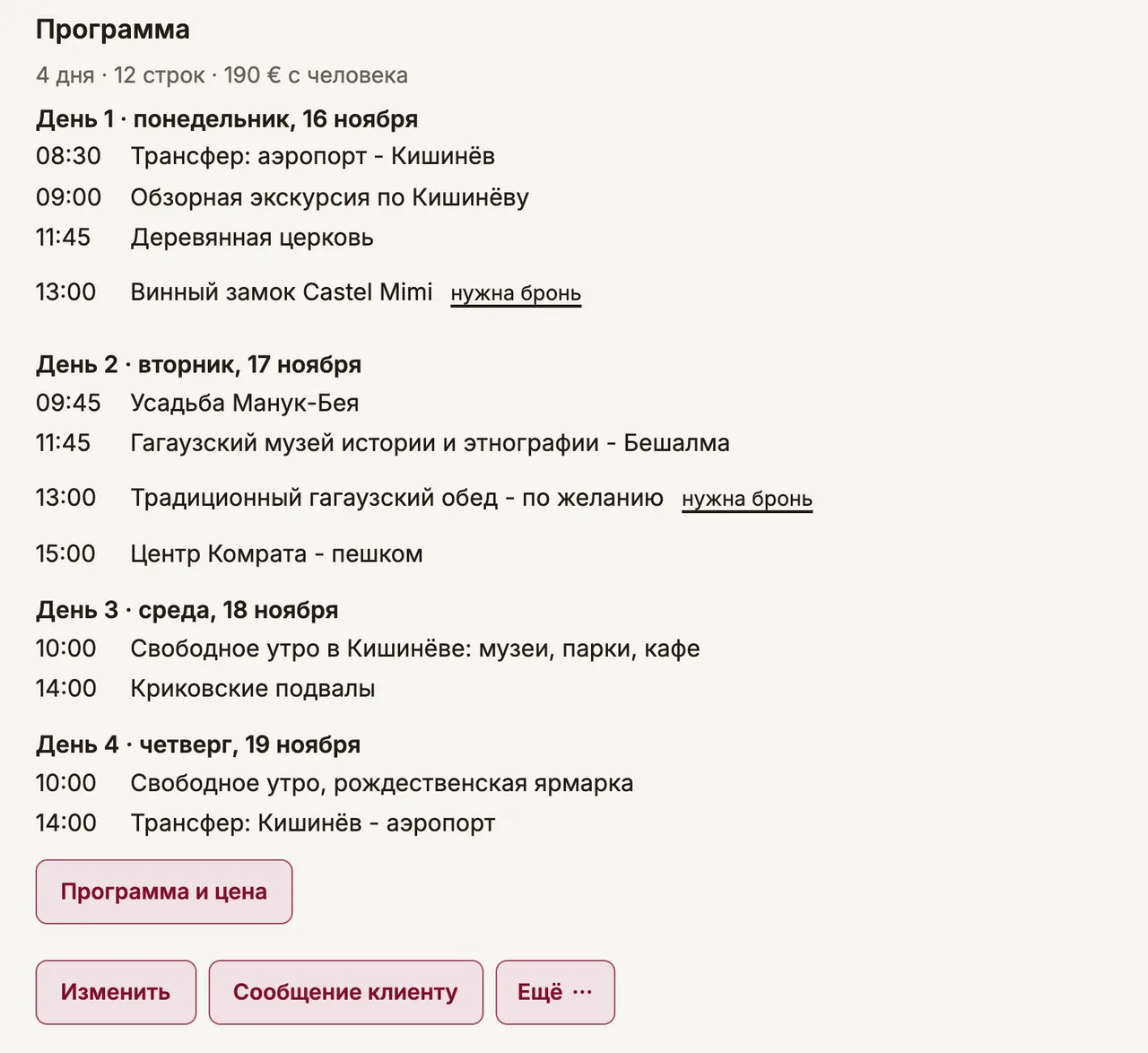
Program
- Person
- The manager builds the day-by-day program in Dispatch.
- System
- Dispatch calculates the price and flags the venues that need a booking.
- Result
- The program turns into a Moldova4You brochure in the customer’s language.
-
3
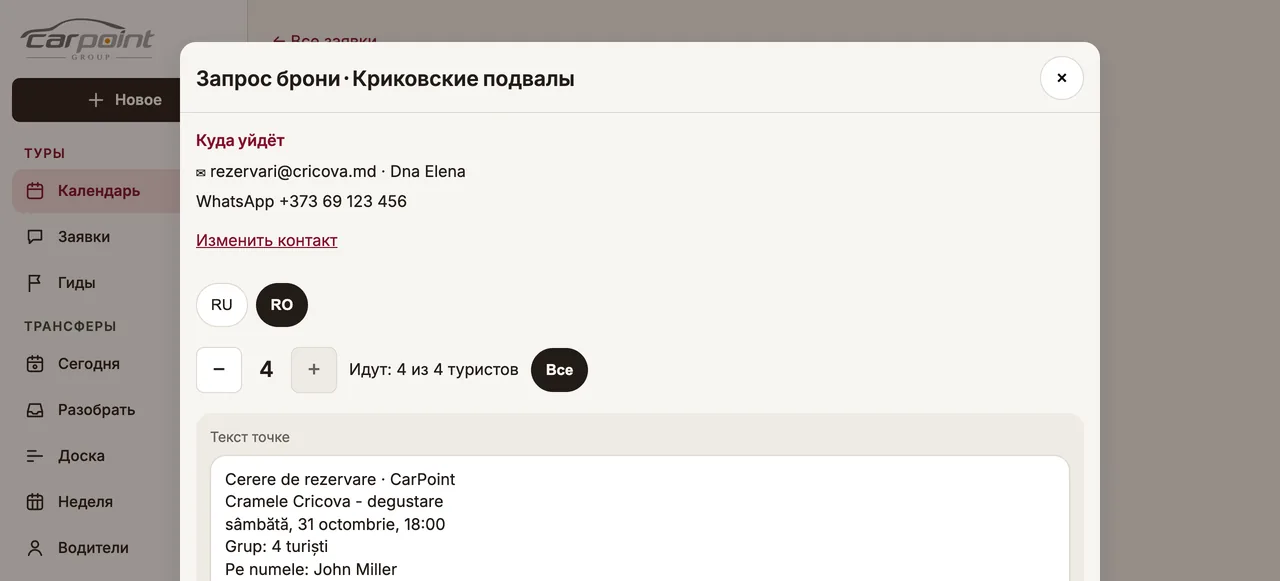
Confirmation
- Person
- The manager checks the booking request and sends it to the winery.
- System
- Dispatch writes the request in the venue’s language with the number of guests and reminds the team until the venue replies.
- Result
- The customer gets a booking document and makes an advance payment, and the winery gets the order.
-
4
Guide, car, driver
- Person
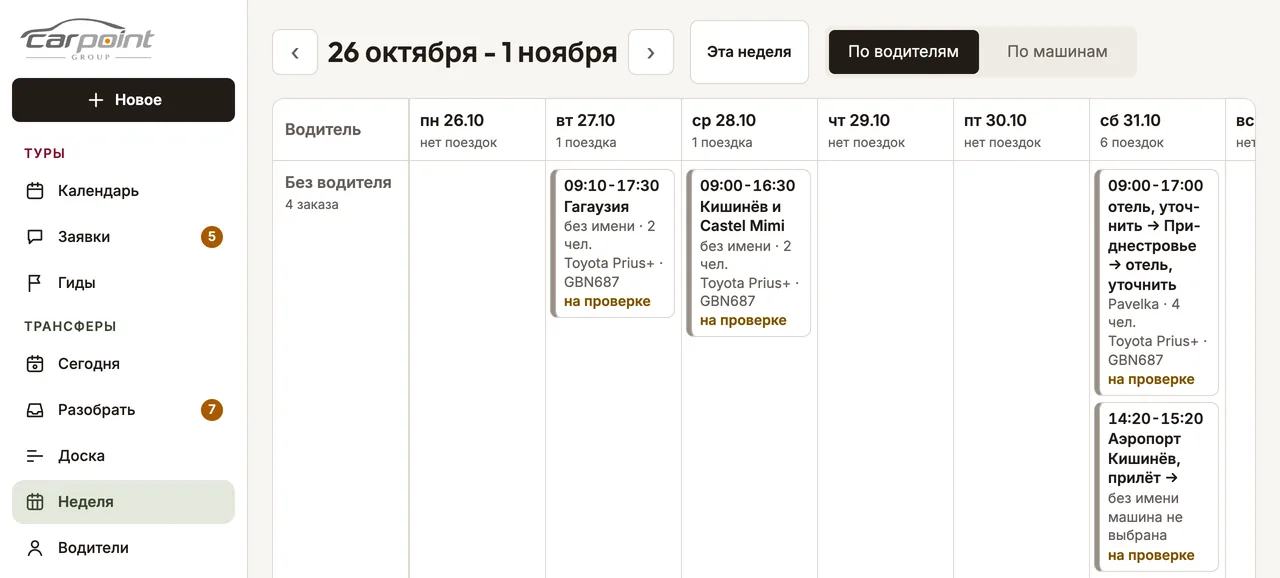
- In the week view by driver, the manager sees trips with no driver yet and assigns one.
- System
- The driver gets a card in Telegram and a calendar event without the price.
- Result
- The tour car shows as busy on the rental website too, so there is no double booking.
-
5
The trip
- Person
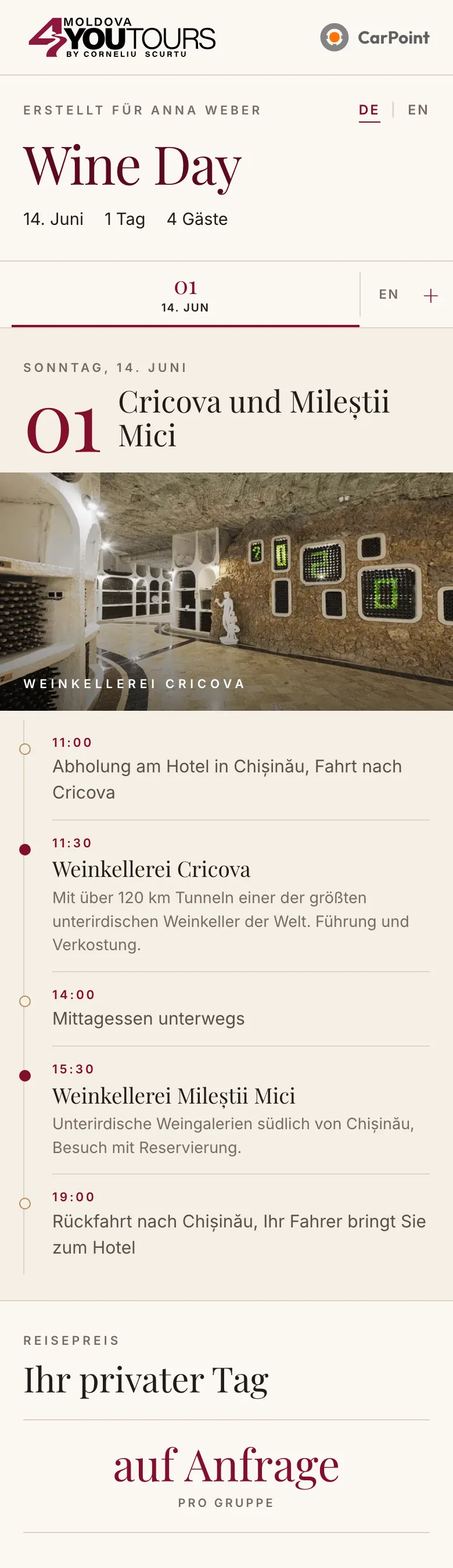
- On June 14, Anna and her guests set off on the “Wine Day” tour with a driver-guide.
- System
- Anna has the day’s program in German, and the driver has a route guide in Russian with waypoints in Waze.
- Result
- The guests know where they will be all day, and the driver doesn’t have to look up addresses.
-
6
Timesheet and pay
- Person
- In the evening, the driver submits the day in the timesheet; the trip is already suggested.
- System
- Receipts are checked, and the hours are matched against GPS.
- Result
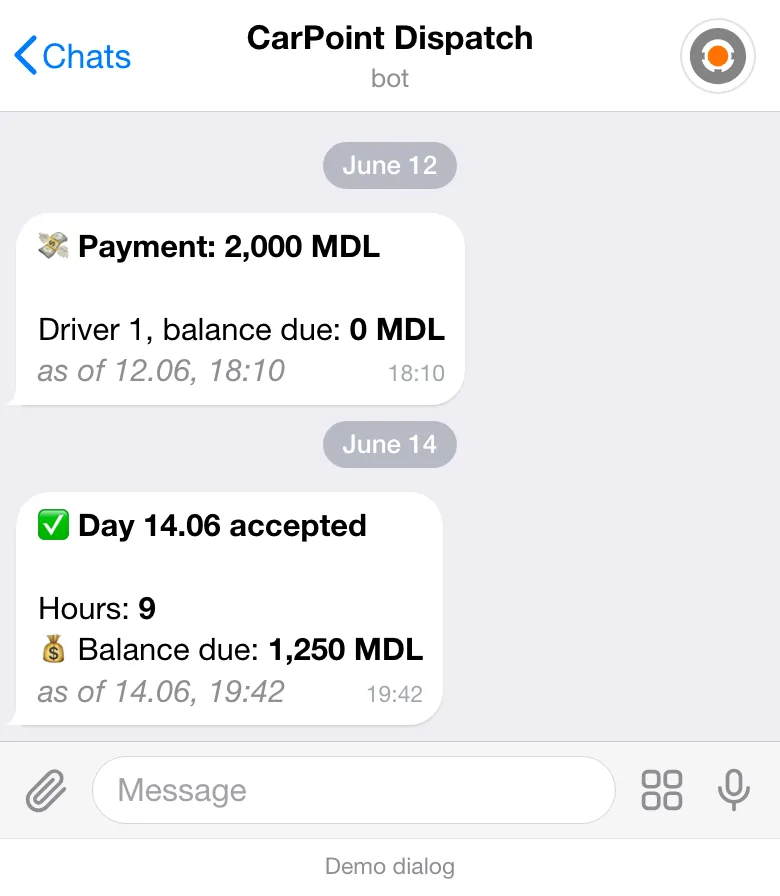
- A Telegram message confirms “Day 14.06 accepted”: 9 hours and the balance due.
System map
What it does, task by task
Website and online booking
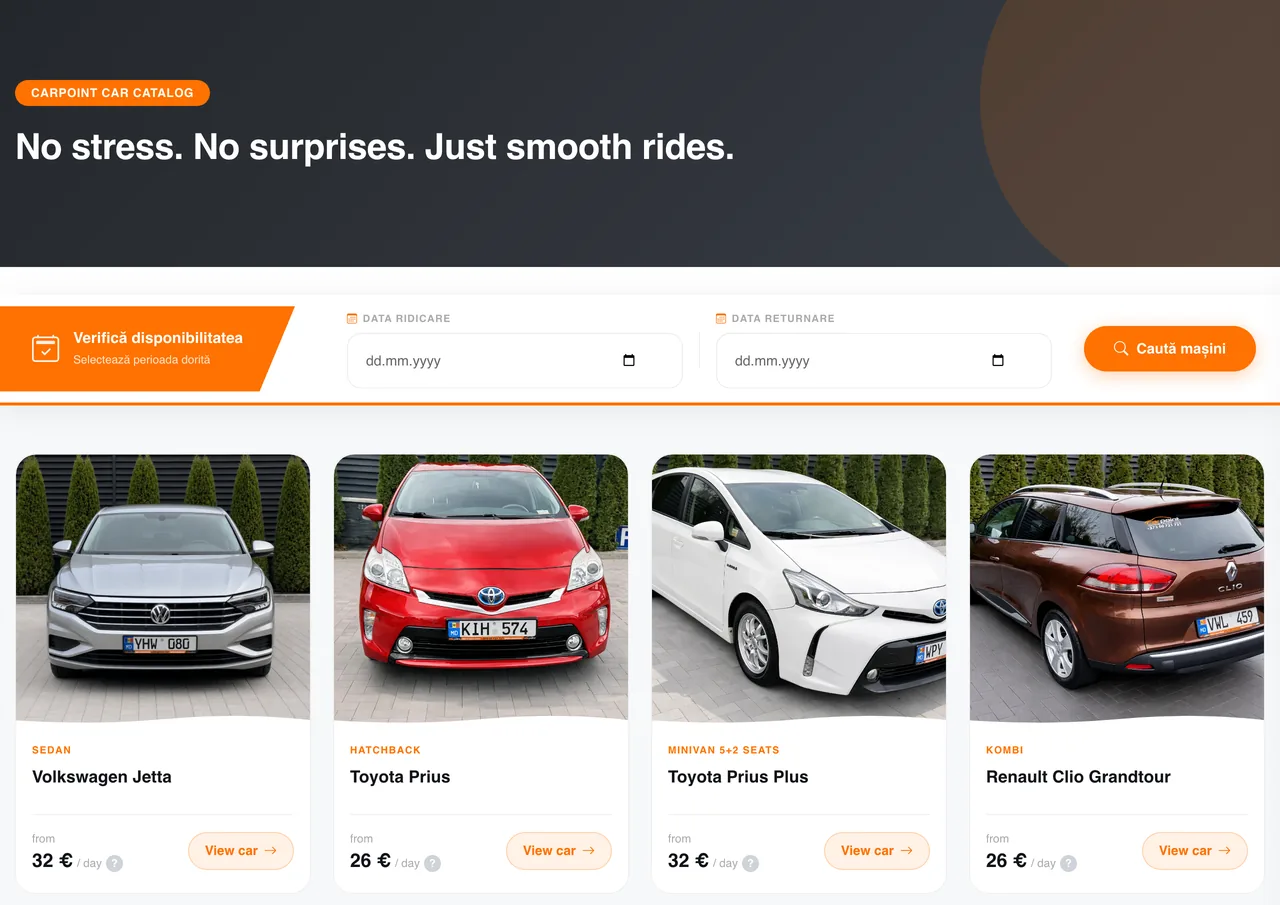
LiveCustomers choose a car, see when it is free and book it without a phone call. The server calculates the price using the company’s rules, and the booking lands in the car’s calendar together with the data for the rental agreement. The old WordPress site calculated nothing, the options had to be explained to customers by hand, and the calendars were kept manually: first on paper, then in Google. In May 2026 we joined everything into one system, and since then we have reworked the site almost entirely.
- Online booking with a booking number, an email to the customer in their own language and a booking card for the team.
- An availability grid on each car’s page shows the hour the car becomes free.
- The server recalculates the price: rates by rental length, CDW, extras, airport and night-time delivery, coupons.
- Each booking is saved to the car’s calendar with hidden fields that the bot later uses to build the rental agreement.
- Extensions and car swaps in the admin panel: a new price, the extra amount due, and the calendar event moves automatically.
- CDW, daily damage coverage: with it, the customer can sign a payment undertaking instead of leaving a cash deposit.
Car availability on the website accounts for rentals, transfers and tours hour by hour. A morning transfer doesn’t block the car for the whole day: once it’s over, the car can be booked again.
Open the website
Operations hub in Telegram
LiveThe company’s daily work runs through a private Telegram bot, the main one among CarPoint’s seven bots: fleet, rentals, transfers, documents, fines and driver pay. A photo of a passport, a driver’s license or a police notice is enough, and the bot reads the data itself. Everything is saved to shared spreadsheets, calendars and cloud storage, with no retyping from one place to another. In practice it is the team’s CRM: bookings, customers, documents and payouts in one chat.
- A rental agreement in a few steps: booking, photos of the customer’s documents, deposit, language, finished PDF.
- Returning customers are recognized, and their documents are offered again. Search by name, phone, booking number, or by car and date.
- Transfers: date, available car, driver. The driver gets a calendar invite without the price.
- Car report: inspection, insurance, oil, battery, brake pads, open tasks and items kept in the car.
- Today’s fleet: which cars are rented and until when, plus each car’s mileage for the day from GPS.
- A name sign for meeting the customer at the airport is generated automatically once a rental agreement with airport delivery is made.
A booking becomes a rental agreement with no retyping. The bot takes the booking data from the car’s calendar, reads the customer’s documents from photos and produces a finished PDF with the company’s signature and stamp.
Tour and transfer dispatch
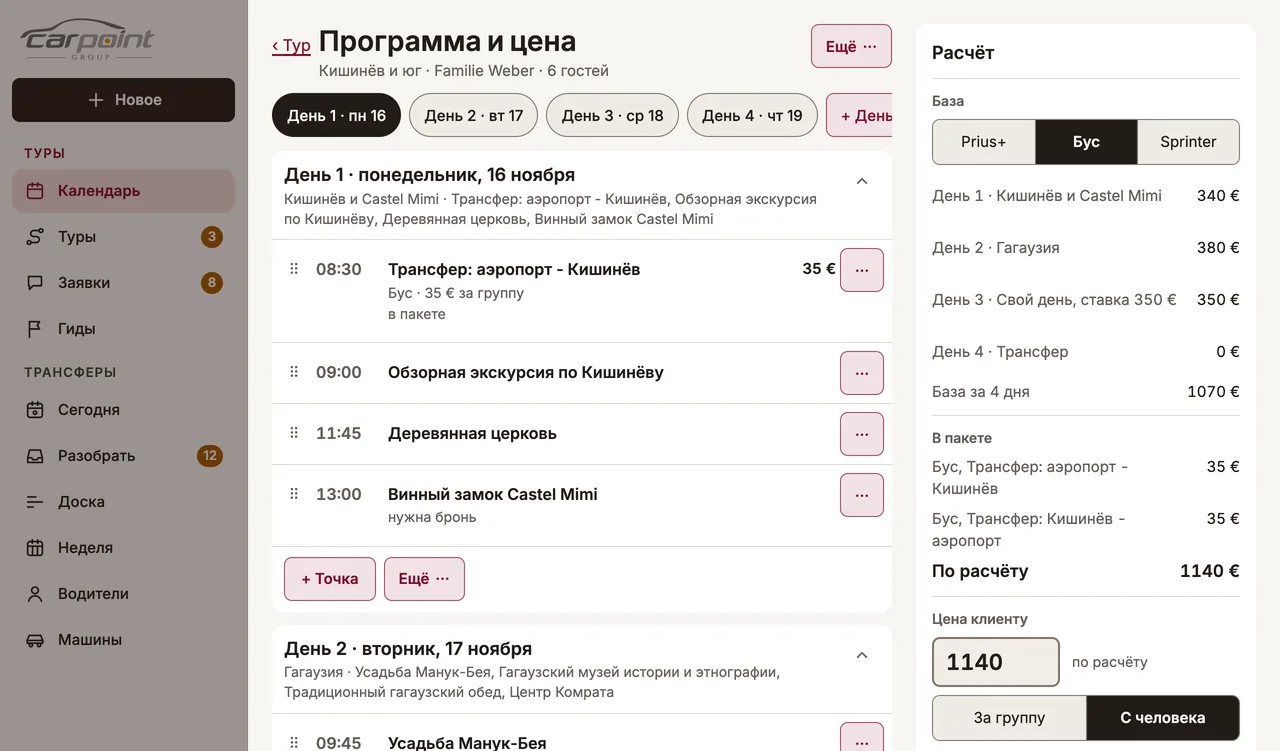
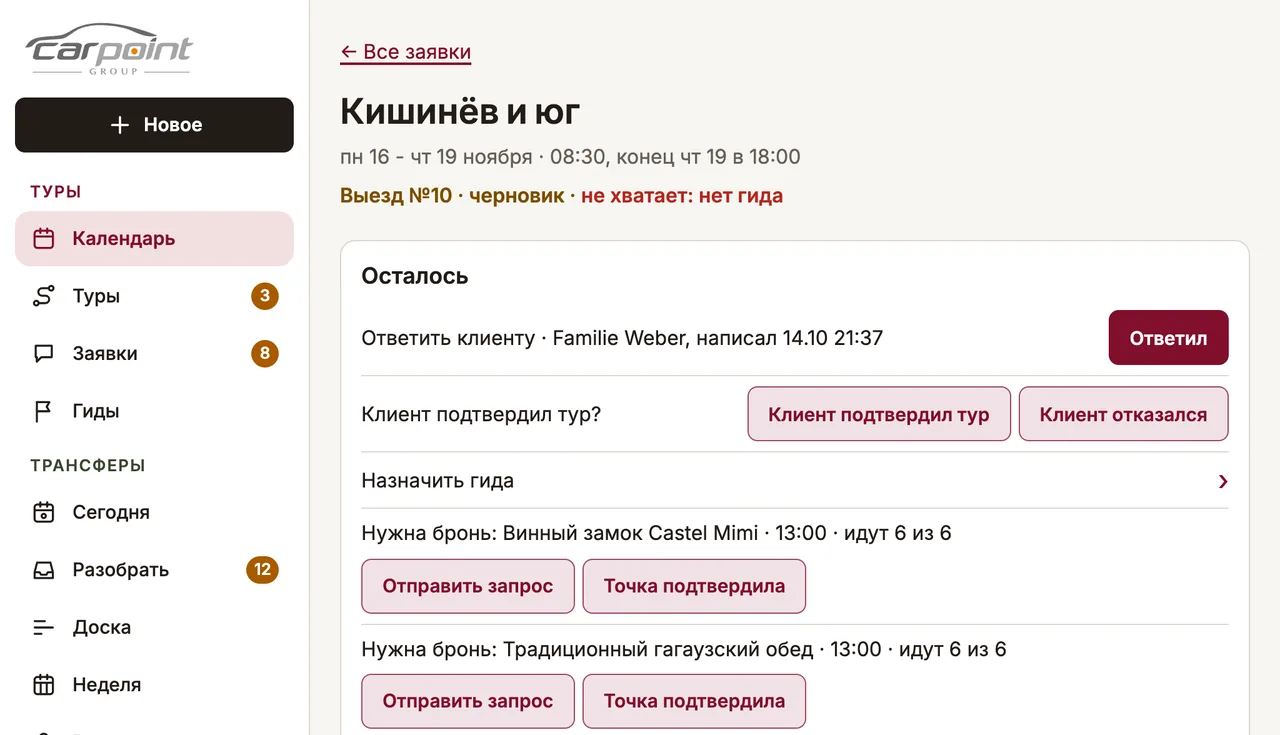
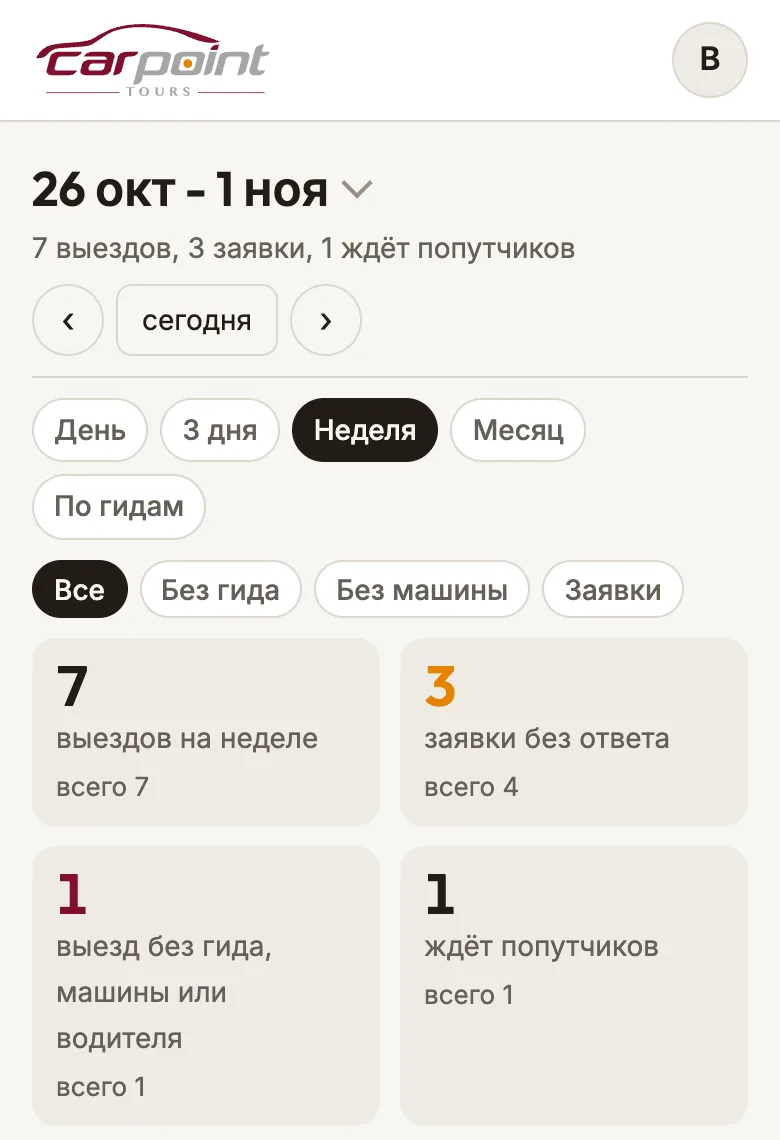
LiveDispatch moved tours and transfers off scraps of paper and chat threads onto one screen. The request, program, guide, car, driver and bookings at wineries and restaurants are all in one place, and the system reminds you what is still left to do. It works on a phone, tablet and laptop.
- Requests from the tours website arrive automatically: dates, who is coming on each day and where the customer came from.
- Program builder: days, venues with options and prices, package price and margin.
- Venue bookings: the order card by email and WhatsApp, an “awaiting reply” status, messages about changes and cancellations.
- Day, week and month calendar: see which guides, drivers and cars are busy.
- The driver gets a trip card in Telegram with an “Accepted” button and a calendar invite without the price or the customer’s phone number.
- Every venue has a navigation link, and a tour exports to a Moldova4You offer with one button.
The catalog has 75 venues, and 29 of them need a booking. One button sends the venue the order by email and WhatsApp. From there, Dispatch holds the “awaiting reply” status, reminds the team until the venue confirms and makes sure nobody forgets to tell the venue about changes.
Drivers: timesheet, GPS, receipts, pay
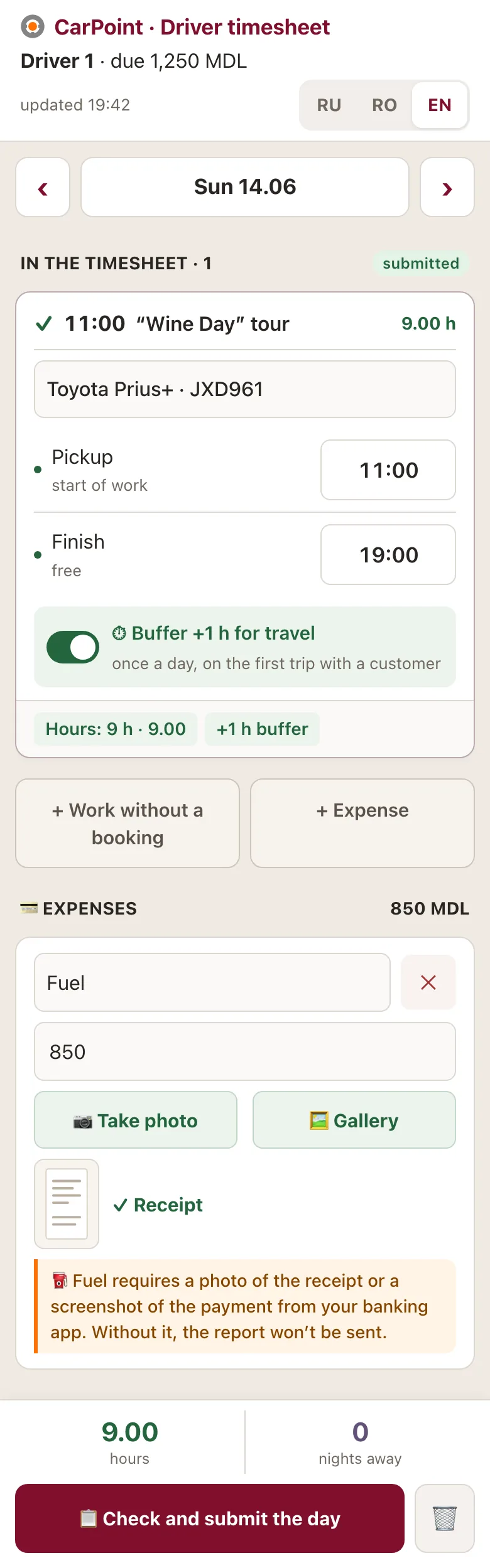
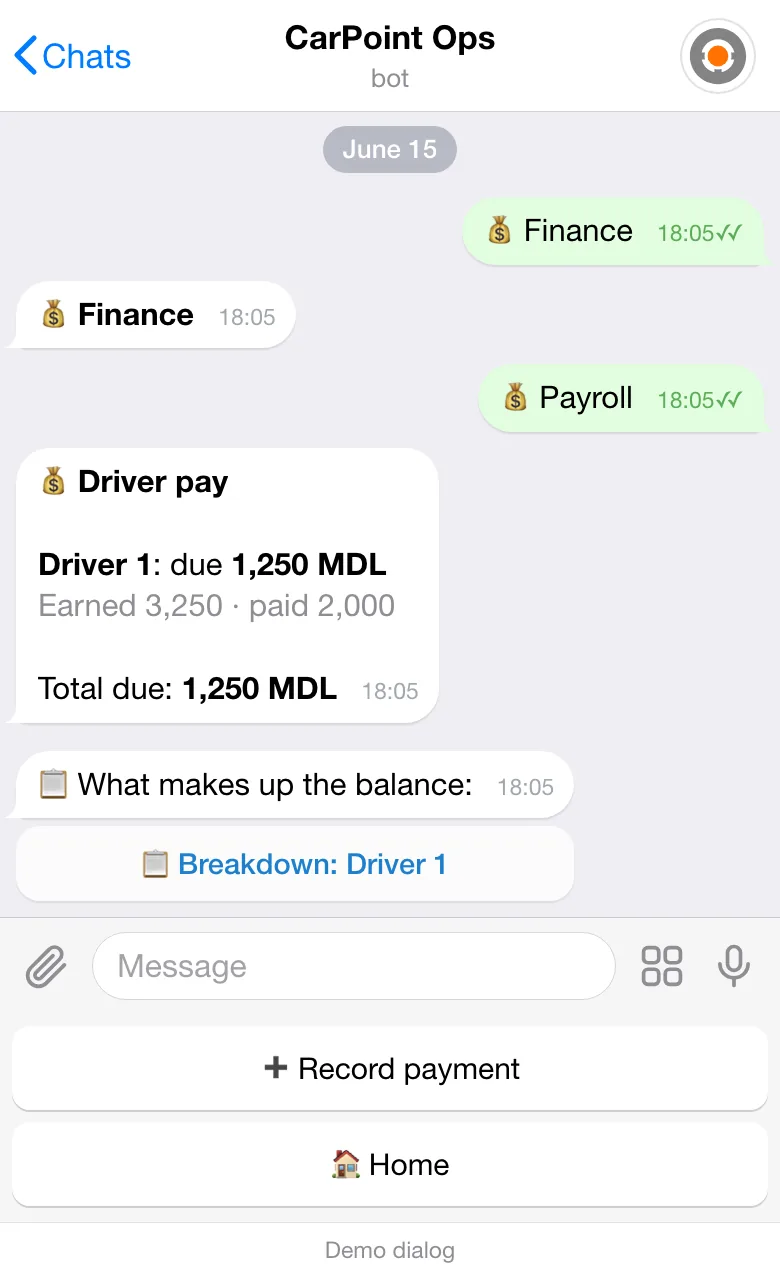
LiveDrivers log each workday in a timesheet on their phone, and pay is worked out from data, not memory. Hours are counted by the rules of the driver’s contract, receipts are checked automatically, and once a week the timesheet is matched against the car’s GPS track. Drivers get their balance due in Telegram, and the owner sees in the bot who is owed what.
- The timesheet installs on a phone like an app: a personal link, one day per form, and drafts are saved even offline.
- “To log” hints: trips from Dispatch that the driver hasn’t entered yet.
- Hours, empty runs and flat-rate transfers are calculated by the rules of each driver’s contract.
- Receipt checks: whether the photo is readable, whether a receipt was submitted twice, whether there is a fuel receipt and whether airport parking matches GPS. The system deducts nothing; it only flags issues.
- Every Monday the timesheet is matched against the car’s track and the calendar, with no AI. The owner only gets the mismatches.
- Pay in the bot: balance, breakdown, payment record, repair deductions and a notice to the driver in their language.
Each trip is linked to the driver’s pay. An order from Dispatch shows up in the timesheet as a hint, the receipt is checked from its photo, the hours are matched against GPS, and once the day is submitted, the driver gets their balance due in Telegram.
Documents and money
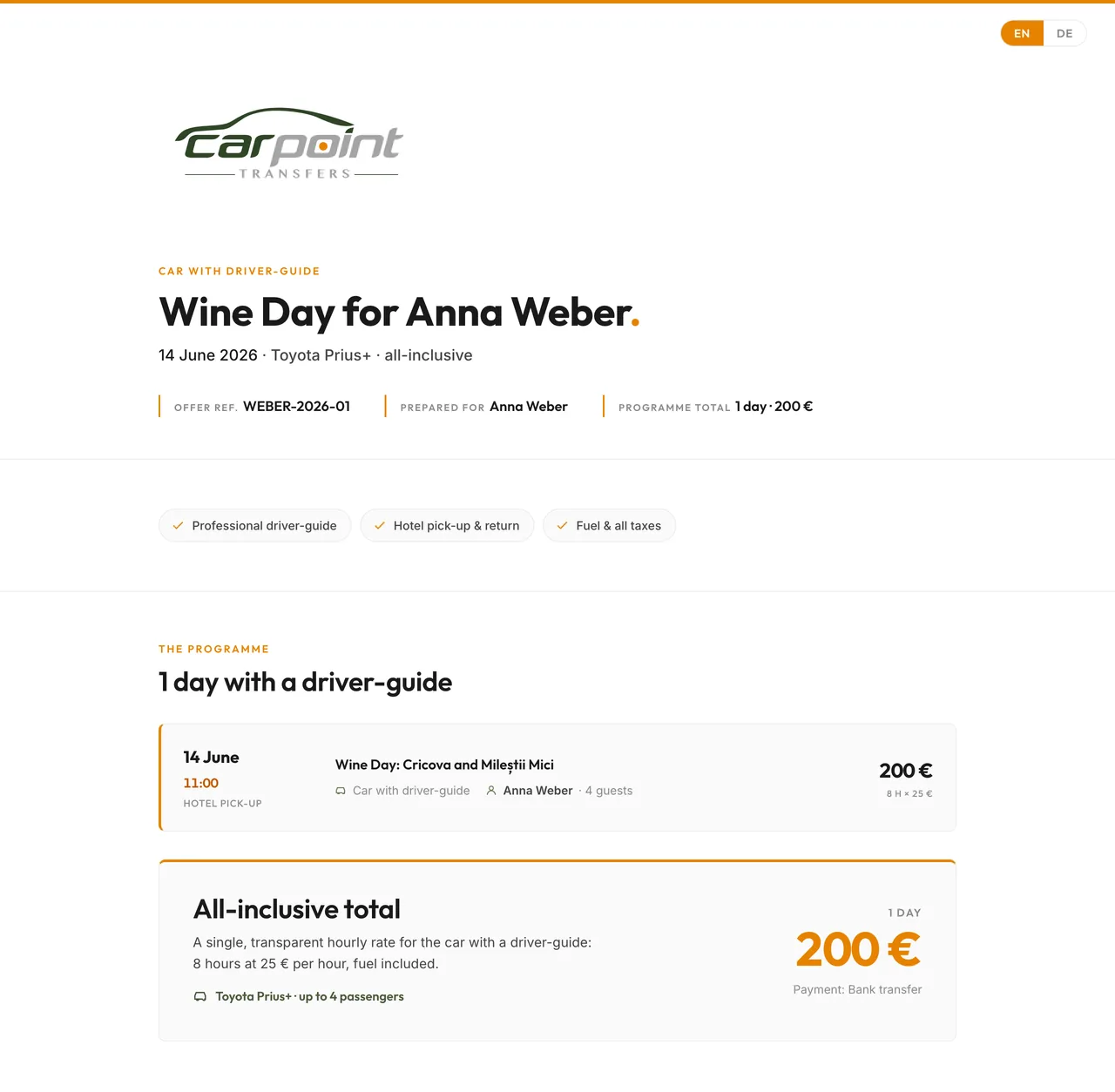
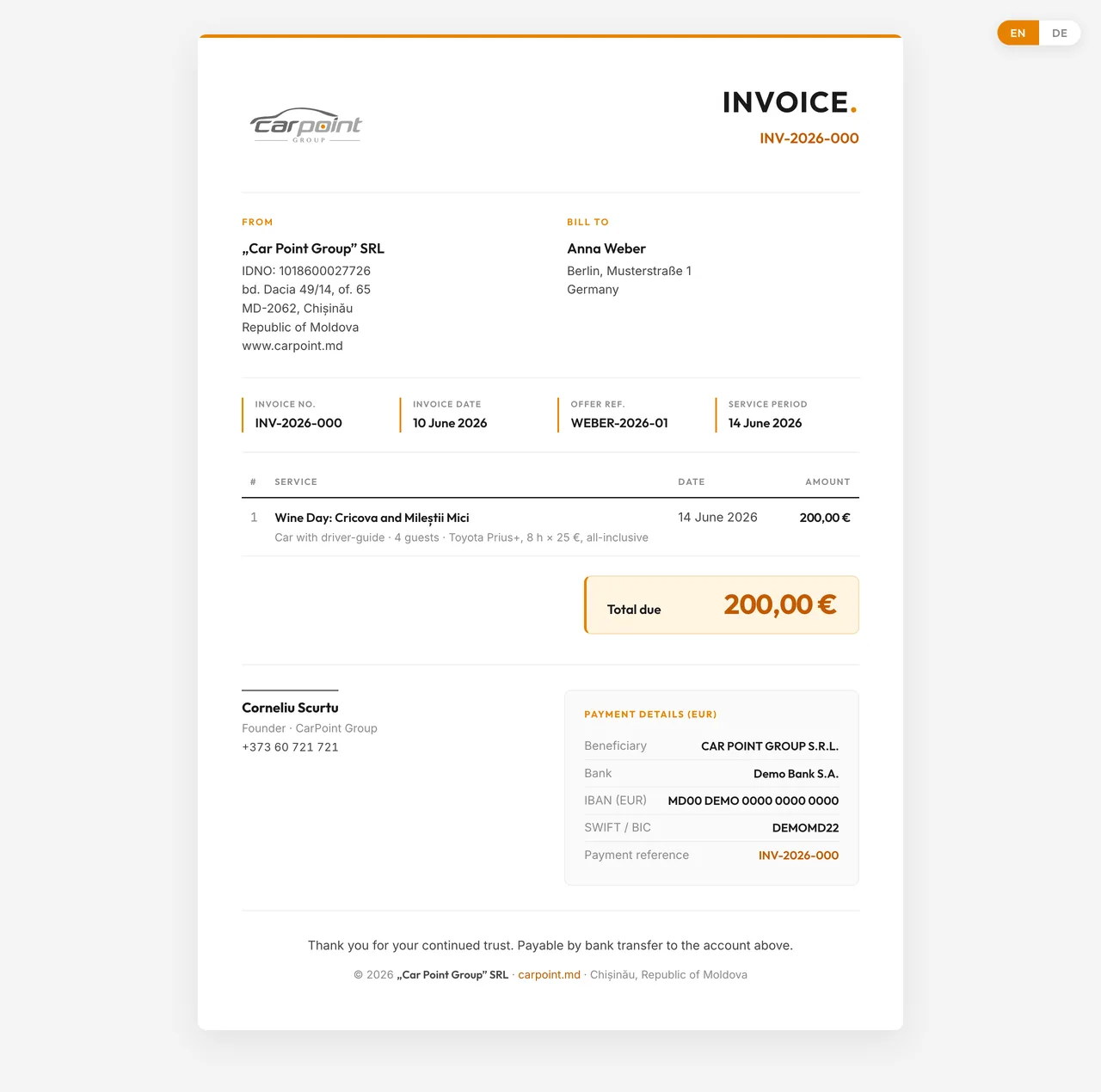
LiveRental agreements, offers, invoices and owner’s declarations for fines are built from data already in the system. A booking, a customer request or a police notice becomes a finished PDF without typing a word. If the customer’s program changes, the offer and invoice are reissued under the same number.
- Rental agreements in a short bilingual version and a full one, with the lessor’s signature and stamp.
- Customer offers: transfers from the request spreadsheet (routes, flights, passengers, cars, prices) or a day with a driver-guide, in one or two languages.
- An invoice from the offer with one button: sequential number, payer details from the directory, PDF.
- Reissue under the same number, marked “Revised”; the calendar syncs without duplicates.
- A police fine notice becomes an owner’s declaration: the bot matches the plate against the fleet and finds who was driving.
- Cash ledger, pilot: each transaction goes in as one line, the engine posts it by double-entry rules, tracks the funds and calculates profit for each car.
A PDF request for 22 transfers becomes an offer, an invoice and events in the car and driver calendars. Routes, flights and passengers come from the customer’s spreadsheet.
Customer communications
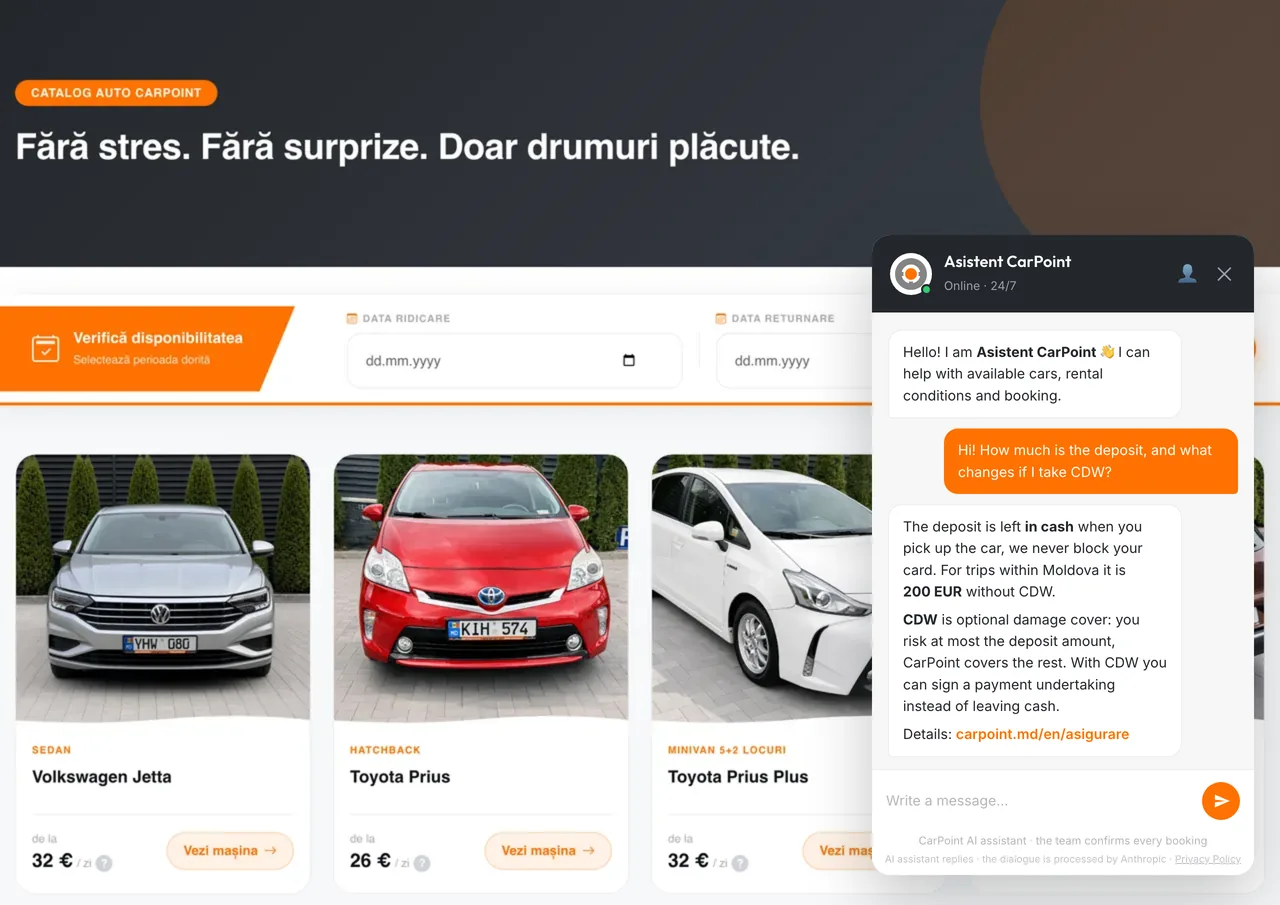
LiveMessages from six channels come together in one Telegram inbox instead of living in separate apps. AI prepares a reply draft in the customer’s language; a person checks it and sends it with a button. Three AI assistants are at work: the inbox copilot, the chat on the rental website and Corneliu’s tour assistant.
- WhatsApp, Instagram, Messenger, email, Telegram and the website chat in one prioritized queue.
- Several messages in a row from one customer merge into one card, and the first message gets a warm hello.
- Edits in Russian, typed or by voice: the reply is rebuilt in the customer’s language.
- The copilot knows the company’s rules: it points rental inquiries to the website and asks follow-up questions about transfers and tours.
- The AI chat on the website answers around the clock, knows the fleet and the terms, takes booking requests at night and calls in a person when needed.
- Corneliu’s assistant: reply drafts in WhatsApp, Instagram, Messenger and on the tours website, booking confirmations and PDF receipts for advance payments.
Six channels in one inbox, and a person makes the call: AI writes the draft, and a real answer reaches the customer only after someone presses the button. WhatsApp itself stays on the phone, in the regular app.
Tours: website, offers, route guides
LiveCorneliu Scurtu’s tours website runs in five languages and sends requests straight to Dispatch. A guide’s draft becomes a branded Moldova4You offer in the customer’s language, with a route map and a PDF. The driver gets a route guide with waypoints for the navigation app; the customer gets their own, with photos and an offline version.
- corneliuscurtu.md: 95 pages in five languages, 14 tour packages, a partner page and a blog.
- A request from the website goes straight into Dispatch along with the source of the visit.
- Tour prices and facts live in one file that feeds the website, the assistants, the blog and the offers.
- A Moldova4You offer from the guide’s draft, whether it’s a PDF, a Word file, a voice message or a chat screenshot: days, stops with photos, a route map.
- A tour exports from Dispatch to an offer with one button, and the offer link is saved back to the tour.
- The driver’s route guide is in Russian with waypoints for Google Maps and Waze; the customer’s is in English or German.
One tour price edit updates the website in five languages, the knowledge base of two AI assistants and the prices in Dispatch. No one has to change the price in each place separately.
Open the website
Content and analytics
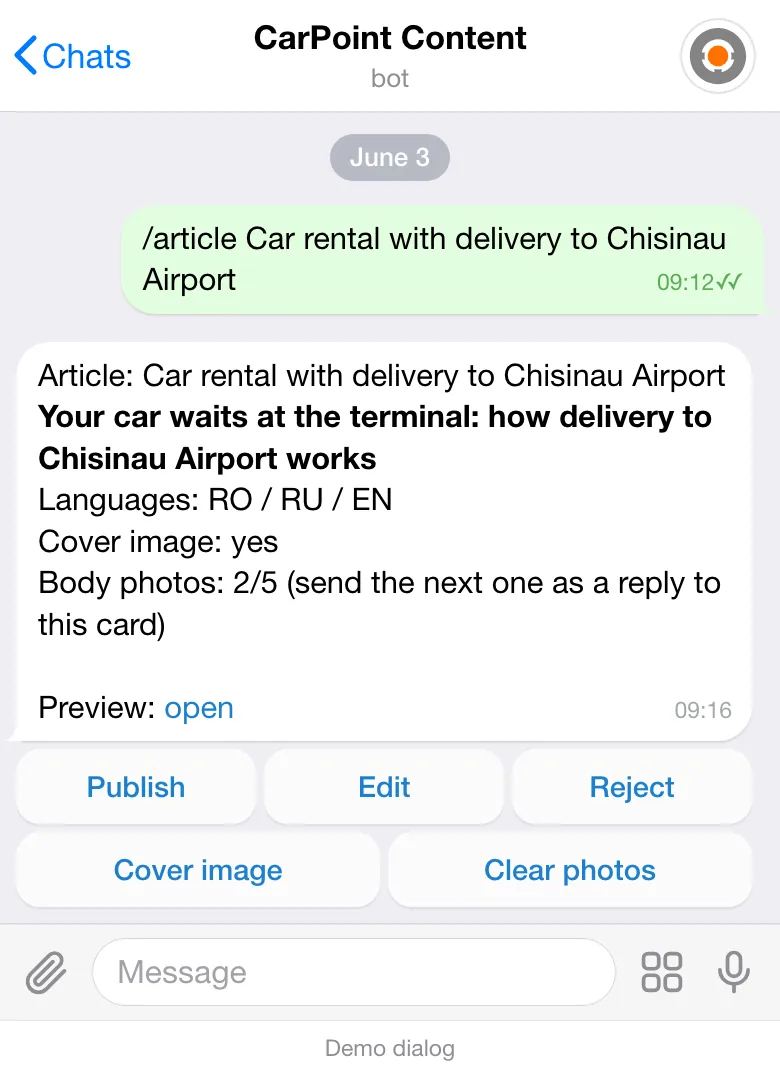
LiveA Telegram bot prepares blog articles and Instagram and Facebook posts, and nothing goes live until the owner presses the button. Dashboards show which posts brought in customers, where inquiries come from and how busy the fleet is compared with last year.
- A content plan and articles for the carpoint.md and corneliuscurtu.md blogs in each site’s languages, with the Russian text written first.
- Posts and carousels for Instagram and Facebook: a preview in the bot, publishing with one button.
- Metrics for every post: reach, clicks from Google, website visits and bookings.
- Customer sources: visit, campaign tag, WhatsApp click, chat start, form.
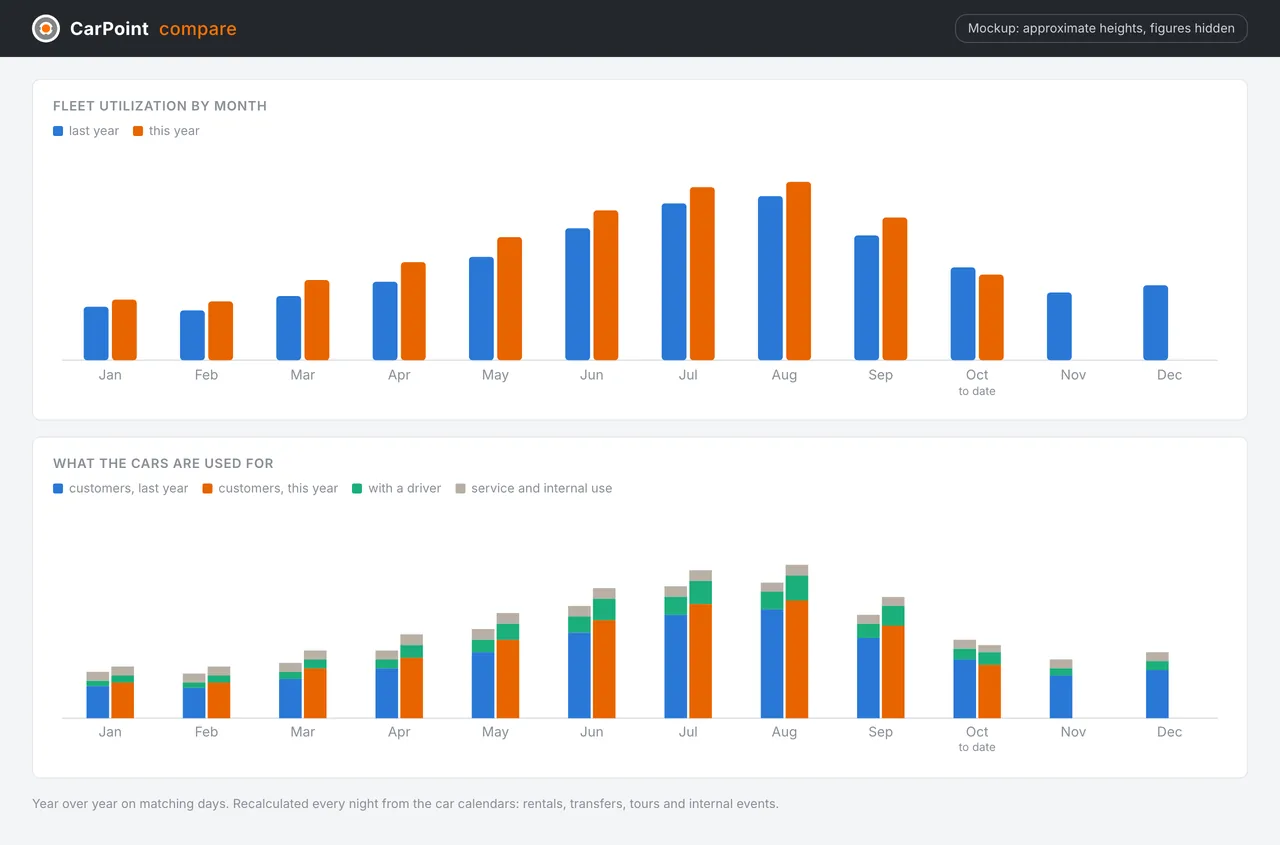
- Monthly fleet utilization compared with last year, recalculated every night from the car calendars, with no amounts.
- A blog digest in Telegram every Monday.
For every post and article, you can see how many bookings it brought in: a tag in the link and website analytics tie the post to the booking.
Background automations
LiveDozens of background jobs run without being asked and send to Telegram what matters today. Insurance and inspection deadlines, oil changes, the daily plan, the website’s health and AI costs are watched without manual reminders. More than five thousand automated tests check the system.
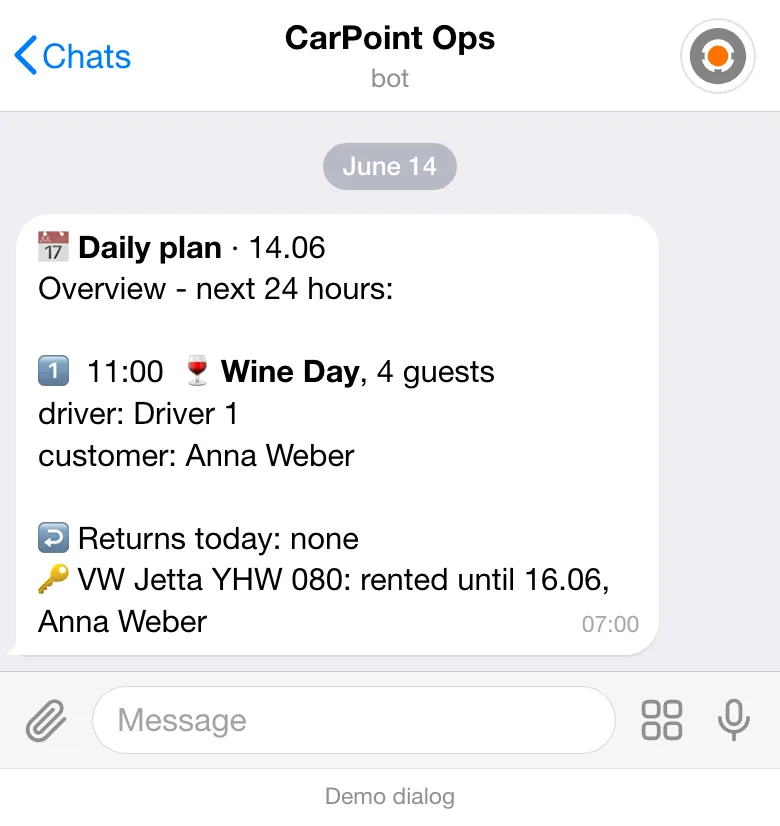
- A daily plan every morning: handovers, returns, transfers and tours for the next 24 hours.
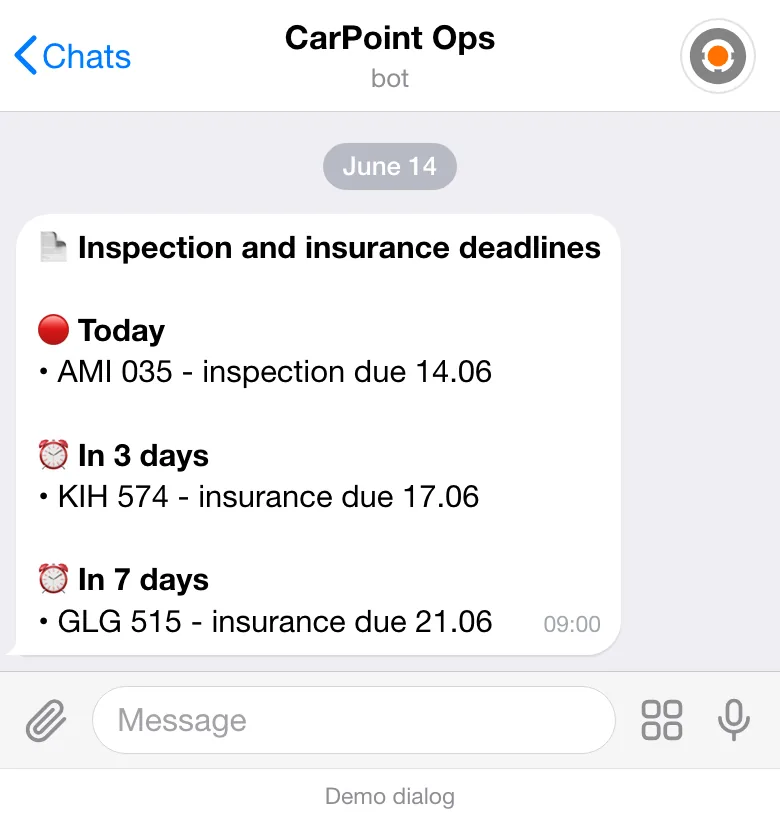
- Inspection and insurance deadlines: overdue, due today, due tomorrow and upcoming.
- Oil changes by mileage, which is tracked by GPS.
- A website watchdog checks the site from the outside every day.
- Digests: AI chat conversation topics, blog summaries, post and article metrics.
- AI costs are visible for each bot, and an alert comes before the balance runs out.
No one has to keep insurance and inspection deadlines in their head: the bot sends a reminder in advance, the day before and on the day itself, and flags oil changes by GPS mileage.
Who built it and how

The 2026 story
-
May
The company’s Telegram work bot and transfer tracking. The tours website corneliuscurtu.md, built in a single day.
-
June
Rental agreements from bookings, invoices and the driver timesheet.
-
July
Six inquiry channels in one inbox.
-
August
An AI chat on the website answers customers around the clock. The tours website gets tour packages with prices and requests straight from the site.
-
September
Dispatch for tours and transfers, and fleet utilization year over year.
-
October
GPS checks for timesheets, receipt checks, a new timesheet version. The tours website: an Italian version built overnight and a rebrand to Moldova4You Tours with a new logo.
Two in-house case studies
- Task
- A driver is paid for hours worked and reimbursed for expenses with receipts. Doing the math from memory leads to disputes.
- Solution
- The driver logs the day in the timesheet on their phone. Receipts are checked from photos, and once a week the timesheet is matched against the car’s GPS track.
- What you see
- The driver sees their balance due in Telegram, and the owner sees in the bot who is owed what. Any discussion is based on data, not memory.
Solutions for other businesses
We build systems and automations for car repair shops, transport companies, rental businesses, cafes and clinics.
Everything you have seen above is used every day at CarPoint. The same approach suits businesses that run on requests, schedules and documents and that settle up with the people they work with.
Typical tasks
- Online appointments and service bay scheduling at a car repair shop.
- Order dispatching and driver management.
- Agreements from document photos, with no manual typing.
- Customer replies in messaging apps: AI writes the draft, a person sends it.
- Records and reports from the data you already have.
How we work
- 1We look at one real workflow: where data gets moved by hand.
- 2We show a prototype built for that workflow.
- 3We agree on scope and price.
- 4We build it into your team’s daily work.
- 5We train your people and support the system.
What do you copy by hand every week? Tell Vitalie about it
Let us know which tasks your team still does by hand and where the data lives today: spreadsheets, email, messaging apps. Vitalie will get back to you and suggest which workflow is the best place to start.